Ridge Vents and Attic Ventilation Brooklyn Park MN
How Attic Ventilation Works in Minnesota Homes
In Brooklyn Park, attic ventilation is not just a building code requirement — it is one of the most consequential decisions made during a roofing project. Minnesota's climate swings from brutal winter cold to humid summer heat, and that range puts unusual stress on roof systems year after year. Ridge vents sit at the peak of the roof and serve as the exhaust point in a continuous ventilation loop. When they work correctly alongside soffit intakes, hot air and moisture exit the attic steadily rather than building up where they cause damage. Understanding how this system functions helps you ask the right questions before any roofing work begins on your home.
What Ridge Vents Actually Do
A ridge vent is a low-profile exhaust vent installed along the entire length of the roof peak. It replaces the old-fashioned approach of placing a handful of box vents or turbine vents scattered across the roof field. The advantage of a ridge vent is coverage — warm, moist air rises naturally to the highest point in the attic, and a continuous ridge vent gives that air a uniform exit path across the full span of the roof rather than forcing it to concentrate at a few isolated points.
In Brooklyn Park homes, ridge vent installation typically involves cutting a slot along the ridge board beneath the cap shingles, installing a baffled vent strip, and then running cap shingles over the top so the vent is nearly invisible from the street. The baffled design is important in Minnesota because it keeps wind-driven rain and snow from entering the attic while still allowing airflow through the vent's external baffle system.
For Attic Ventilation to perform as designed, intake and exhaust must be balanced. Ridge vents handle exhaust. Soffit vents — the perforated or slotted panels along your eaves — handle intake. Without adequate soffit venting, a ridge vent cannot draw air effectively. This intake-to-exhaust balance is often what gets missed during installation, particularly in older Brooklyn Park homes where soffits may be blocked by insulation blown in years earlier.
Why Minnesota's Climate Makes Ventilation Critical
Brooklyn Park sits in a climate zone where attic performance is tested from two completely different directions. During July, attic temperatures in poorly ventilated spaces can climb above 150 degrees Fahrenheit. That heat radiates down into living spaces, increases cooling loads, and accelerates shingle aging by cooking the asphalt from the underside. Heat degrades shingle adhesive strips and can void manufacturer warranties if the attic runs consistently too hot.
In winter, the threat is different. Warm indoor air carries moisture upward through the ceiling into the attic. If that air stalls in an unventilated or underventilated attic, it condenses on the cold roof deck and rafters. Over time, that moisture causes wood rot, weakens the decking, and feeds mold growth inside the attic cavity. Brooklyn Park homes with inadequate attic ventilation often show early decking deterioration when roofs are torn off for replacement — a problem that could have been slowed significantly with proper exhaust ventilation.
Ice dams are another direct consequence. When the attic stays warm in winter because hot air has no exit, snow on the roof melts from below, runs down to the cold eaves, and refreezes. That cycle creates ice dams that force water under shingles and into the structure. Ridge vents that allow the attic to stay cold — matching exterior temperatures — help break that cycle by removing the heat source that drives melting.
Ridge Vents Versus Other Exhaust Options
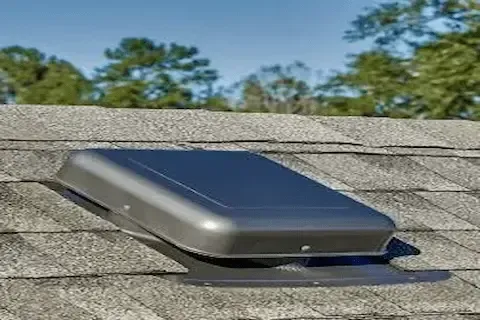
Box vents, turbine vents, and power attic ventilators are all alternatives to ridge vents, and each has a place in certain applications. Box vents are static exhaust points that work acceptably in small or oddly shaped attic spaces. Turbine vents use wind energy to pull air out and can move significant volume on windy days but become ineffective in calm conditions, which limits their reliability in Brooklyn Park's variable weather. Power attic ventilators run on electricity and move large volumes of air but can actually depressurize the attic and pull conditioned air from living spaces if the home is not well sealed, creating energy loss rather than savings.
Ridge vents avoid most of these drawbacks. They are passive, so there is no power consumption, no moving parts to fail, and no risk of creating negative pressure. They work in all wind conditions because they rely on the natural convection of rising warm air rather than wind speed. For most standard gabled roofs in Brooklyn Park, a continuous ridge vent paired with open soffits represents the most reliable and low-maintenance exhaust solution available.
Common Problems with Existing Attic Ventilation
Many Brooklyn Park homes were built before modern ventilation standards were well understood, and roofing projects completed in the 1980s and 1990s often mixed vent types in ways that create problems rather than solve them. One of the most common mistakes is combining ridge vents with upper-slope box vents. When two exhaust points exist on the same roof, air can short-circuit — entering through the lower box vent and exiting through the ridge vent without ever pulling fresh air in from the soffits below. The result is poor ventilation despite the appearance of a complete system.
Blocked soffits are equally common. In Brooklyn Park homes with blown-in attic insulation added after original construction, installers sometimes buried the soffit baffles or rafter channels, cutting off the intake path entirely. A ridge vent installed on a home with blocked soffits accomplishes almost nothing because air cannot flow in to replace what exits. Before installing new ridge vents, a roofer should confirm that the soffit intake is clear and adequate — ideally with a net free area that matches or exceeds the exhaust area at the ridge.
You can also read our breakdown on ventilation versus insulation compared to understand how these two systems interact and why addressing one without the other often leaves performance gains on the table.
What to Expect During Ridge Vent Installation
If your Brooklyn Park roof is being replaced, ridge vent installation is typically straightforward to incorporate into the project. The roofer removes the existing cap shingles, cuts a continuous slot along the ridge, installs the vent strip, and finishes with new cap shingles. The process adds minimal time to a full replacement and is far less disruptive than retrofitting ventilation to an existing roof.
On an existing roof in good condition, a retrofit is possible but more involved. The cap shingles must be carefully removed and replaced, which increases the chance of minor disruption to adjacent shingle courses. The quality of the retrofit depends heavily on how carefully the contractor handles the existing shingles and whether the slot width is cut to match the specific vent product being installed. Ask your roofing contractor which vent product they use and confirm it carries a warranty that covers both the vent itself and its weatherproofing performance in cold climates.
Making the Right Call for Your Brooklyn Park Home
Ridge vent installation is a straightforward improvement with long-term consequences for shingle life, structural integrity, and energy performance. For most homes in Brooklyn Park, continuous ridge ventilation paired with open soffit intake represents the most effective passive system available. Getting it right means looking at the full picture — not just installing a vent at the peak, but confirming that intake, exhaust, and attic airflow work together as a connected system rather than isolated components.
